Tips for Choosing the Best Assisted Living Software in 2025

Recent data shows that more than 1,000,000 Americans currently reside in assisted living. In the coming years, that figure will only rise because experts project that the population of adults aged 85 and older will increase from 6.7 million in 2020 to 14.4 million in 2040 (+117%).
In fact, according to Consumer Affairs, seven out of 10 people will require assisted living care in their lifetime. With that level of growth, assisted living communities that want to compete will need to optimize and streamline operations while also attracting new residents and providing the best care and service. That’s where choosing the right software solutions sets organizations apart.
Why the Right Software is Essential for Delivering Better Care and Running a Smarter Community
Assisted living communities today are managing more residents, more regulations, and more complexity than ever before. However, they’re often doing it with outdated systems or disconnected tools.
Without the right software in place, common challenges emerge:
- Difficulty staying survey-ready due to inconsistent or incomplete documentation
- Risk of service creep and lost revenue from unbilled care or mismanaged service logs
- Communication breakdowns across nursing, operations, and administrative teams
- Time-consuming manual paperwork that pulls staff away from resident care
Paper-based processes and siloed tools can leave you vulnerable to compliance issues, data inaccuracy, and burnout. Some of that may have worked in the past, but it won’t support the growing demand and expectations of today’s residents and families.
Benefits of Implementing Purpose-Built Senior Care Software
When assisted living communities implement a centralized, purpose-built platform, they gain tools that help every department operate more effectively. From documentation to resident engagement, software designed for senior care transforms day-to-day efficiency and long-term outcomes.
Centralized Data and Real-Time Access
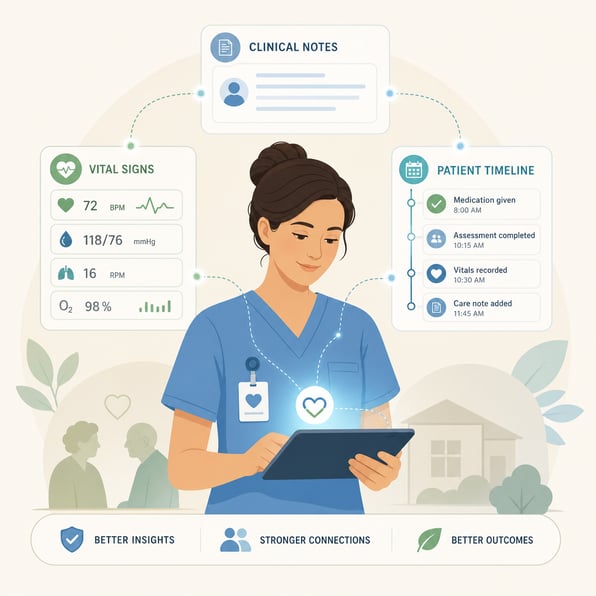
When your team has to piece together information from different systems, critical details slip through the cracks. A centralized platform brings all clinical, operational, and financial data into one place, so everyone’s working with accurate, up-to-date information. No miscommunication. No duplicate entry. Just clear insights when you need them.
Stronger Compliance and Audit Readiness
Compliance doesn’t start the week before a survey. It happens in the daily workflows that keep documentation on track and assessments up to date. Purpose-built software automates this process so your staff can stay compliant by default.
More Accurate Billing and Service Tracking
Service creep is subtle (but costly). When scheduled and unscheduled services aren’t properly logged, your community ends up delivering more care than it bills for. Over time, that erodes margin and creates confusion for families. Purpose-built software can ensure accurate billing and give families a clear picture of exactly what their loved one is receiving.
Improved Communication Across Roles
Assisted living is a team effort, but most teams rely on hallway conversations, sticky notes, and shift binders to keep each other updated. Software that supports role-based views, shared notes, and task management ensures that nothing gets lost and every staff member knows exactly what’s happening with each resident.
Smarter Occupancy and Resource Planning
When care data integrates with marketing and billing systems, operators gain complete visibility into trends, availability, and performance. That means more accurate forecasting and proactive resource allocation.
Better Quality of Life for Residents
When staff spend less time documenting and more time caring, everything improves. Residents receive more personalized, timely support, and staff can identify early risks or needs using real-time notes and behavior patterns.
Reduced Staff Burnout and Turnover
Your caregivers don’t want to fight with the software. Purpose-built systems are intuitive, user-friendly, and responsive. That leads to higher job satisfaction, lower burnout, and a team that’s more likely to stick around.
Factors to Evaluate When Selecting Senior Living Software
Each senior care community is different, so you should consider your community's needs when selecting management software. Below are some of the most important factors to consider during the evaluation stage.
Experience and Expertise
Look for software solutions with a proven history of improving services, increasing occupancy, and optimizing revenue. In addition, seek solutions that address the specific needs of senior living communities as opposed to software designed for other healthcare systems.
Software systems like Eldermark, which has three decades of experience in providing assisted living solutions, are designed with the needs of residential senior living communities in mind.
Variety and Suitability
Select a solution that’s suitable for the size of your senior living community. Not all software is scalable for large communities with many moving parts. Other options may not be optimal for smaller communities with more precise needs. Additionally, ensure it offers a comprehensive suite of options, including cloud-based access, functions for clinical management, administration, marketing, and analytics.
Resources and Support
Look for providers that offer 24/7 support for their products. On-demand tech support is critical for communities that rely on technology to ensure resident safety. Another factor to consider is what types of training the platform offers for new staff or when it releases updates.
Pricing
When determining a price that suits your budget, remember to factor in the funds that comprehensive software providers can bring through reduced costs, streamlined workflows, and targeted marketing.
Types of Assisted Living Software
The right assisted living platform brings together the many moving parts of your community, including care delivery, communication, compliance, billing, marketing, and more. While the options may vary, most platforms fall into four key categories. Each type supports a core area of operations and, when integrated, helps you run a more coordinated, efficient, and responsive community.
Point of Care Software
These tools help your team document efficiently, track resident needs in real time, and reduce errors by streamlining day-to-day workflows.
- Electronic Health Records (EHR): Centralized vital resident information (e.g. care plans, vitals, assessments) into a system that's accessible by the care team at the point of service.
- Electronic Medication Administration Records (eMAR): Ensures that the right resident receives the correct does of their prescribed medication at the appropriate time.
- Monitoring & Risk Management: Gain early visibility into health changes, behavior shifts, and safety concerns with alerts, fall tracking tools, and more.
- Compliance Tools: Support state-specific compliance with built-in assessments, documentation workflows, audit logs, and reporting tools.
Customer Relationship Management (CRM) and Marketing Software
Sales and marketing tools help you attract, track, and convert leads while giving operations teams better visibility into upcoming move-ins and resource planning.
- CRM Software: Manage leads, tours, and communication across locations with reporting that supports occupancy forecasting and operational planning.
- Marketing Automation: Streamline campaigns, manage lists, and target prospects with personalized follow-ups based on interest, readiness to move, and more.
- Digital Marketing Support: Some platforms also include or integrate with services that improve how you promote your community online.
Administration Software
Software that supports your financial and admin teams takes the pressure off busy staff, keeps things organized, and helps you manage revenue with more clarity and less stress.
- Billing and Invoicing: Automate service tracking, invoicing, and payer-specific billing to reduce service creep, lower errors, and ensure accurate revenue capture.
- Payment Processing: Allow residents or families to view or pay invoices online through secure portals or tools integrated with your billing system.
- Accounting Integration: Align with general ledger and payroll tools for smoother financial workflows and fewer duplicate entries.
Analytics and Executive Management Tools
These systems turn your raw data into actionable insights for administrators and executives.
- Dashboards & Reporting: Review real-time occupancy trends, care delivery metrics, compliance readiness, and team performance at a glance.
- Predictive Analytics: Tools like ElderSmarts help communities anticipate risks like falls, hospitalizations, or staffing concerns and respond proactively.
Integrated Platforms Provide the Full Picture
While standalone tools can offer value, communities see the biggest results when these systems work together. Integrated software means your team spends less time entering the same data in multiple places and more time focusing on quality of care and the resident experience. With an all-in-one platform, you get a full picture of your community.
Best Senior Living Software in 2025
With all that in mind, let's take a look at the best senior living software options in 2025.
|
Feature/Platform |
Eldermark |
ECP |
MatrixCare |
HubSpot |
|
EHR |
Yes |
Yes |
Yes |
No |
|
eMAR |
Yes |
Yes |
Yes |
No |
|
CRM |
Yes |
Yes |
Yes |
Yes |
|
Billing |
Yes |
Yes |
Yes |
No |
|
Engagement Tools |
Yes |
No |
No |
No |
|
Compliance Tools |
Yes |
Yes |
Yes |
No |
|
Senior Care Specific |
Yes |
Yes |
Partially |
No |
Eldermark
With over 30 years of experience in the sector, Eldermark is the leading, most trusted senior living software provider. Suitable for small, medium, and large communities, Eldermark focuses exclusively on senior and assisted living. Eldermark's long-term care software platform offers a comprehensive array of options to handle all the needs of a senior living or assisted living community.
Eldermark incorporates aggregating and analyzing data across the community spectrum. We provide actionable insights for improvements across various metrics through real-time reports, performance indicator analysis, and business intelligence.
Key solutions include:
- EHR
- eMAR
- CRM
- WISDOM2ACT real-time monitoring software
- Resident engagement and activities platforms
- Billing and payment software
- Marketing automation
- Business analytics
- Training and 24/7 support
→ Explore Our Full Product Library
ECP
Founded in 2004, ECP is a cloud-based EHR solution designed for independent and assisted living communities, memory care communities, and residential communities for individuals with developmental disabilities. It's a relatively new, fast-growing company offering solutions for a broad array of care communities.
Key solutions include:
- EHR
- eMAR
- CRM
- Billing and payment software
- Move-in tracking
MatrixCare
MatrixCare is a long-standing company offering software for a broad range of organizations, including senior living communities. However, it has expertise in various healthcare sectors, including EHR solutions for assisted living communities.
Key solutions include:
- EHR
- eMAR
- CRM
- Billing and payment software
- Business analytics
- Training and marketing
- Nutrition management
- Financial and operations management
HubSpot
Although not specifically tailored to senior and assisted living communities, HubSpot is one of the most popular general-purpose CRMs, is easy to use, and has powerful automation and intuitive marketing features.
Key solutions include:
- Sales CRM
- Content management software
- Marketing automation
- Operations software
- Customer relations
Request a Free Demo with Eldermark to Get Started
The ultimate goal of an assisted living community is to adhere to professional, safe practices that prioritize the well-being of staff and residents while keeping your community financially thriving. With Eldermark NEXT we provide the tools, resources, and support to make that a reality.
Our platform was created by former senior living nurses and operators who have industry knowledge and experience. Eldermark NEXT is the ultimate solution for the unique needs of senior care communities.
Ready to get started? Schedule a demo or contact our team today.
FAQs
What factors should be considered when choosing software for an assisted living community?
Senior living community managers should consider whether software packages offer the functionality the community needs. In addition, they should consider scalability, customizability, access to tech support, and attention to regulatory compliance.
What types of software are commonly used in assisted living communities?
Communities typically need software for three main functions. Point of care software to manage direct care for residents. Customer relationship management and marketing software to drive sales, marketing, and revenue generation. Administrative software for billing, staff management, and community management.
What kind of training and support options are typically provided by software vendors?
Eldermark offers training and 24/7 support for our software solutions. Support options include phone support, online chat, a library of downloadable support documents, and training videos.
Can software help with engagement, family communication, and over resident satisfaction?
Point-of-care software can ensure residents receive the correct care and track their participation in community activities. Portals and mobile apps allow families access to their loved ones’ profiles to stay fully informed about their care and quality of life.
Are there any success stories that highlight the impact of software in an assisted living community?
Eldermark clients speak to the value of implementing senior living community management software solutions. To hear specific examples, visit our Testimonials page.
Book a Meeting to learn more!
Posts by topic
.png?width=596&name=Blog%20Part2%20Images-selection%20(3).png)