Maryland Assisted Living Operators: COMAR Compliance

Medication management in assisted living is harder than it looks on paper.

Maryland's updated COMAR regulations require assisted living programs to maintain complete, real-time, audit-ready medication records. OHCQ surveyors began issuing citations for non-compliance in May 2026. Paper MAR cannot consistently meet that standard.
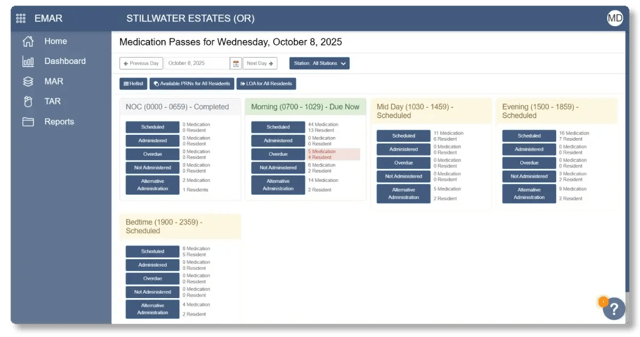
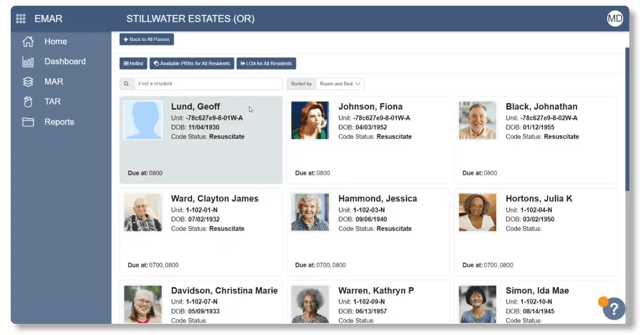
Eldermark eMAR on laptop, medication administration record showing scheduled medications for a resident
Eldermark eMAR desktop, clinical leader monitoring medication administration activity building-wide
Why It Matters for Assisted Living Communities in Maryland

Maryland raised the bar. Paper MAR can't clear it.

Medication management in assisted living is harder than generic healthcare content usually makes it sound. Residents are moving in later. Acuity is rising. Medication lists are longer. Orders are more complex.

A single med pass may involve routine medications, PRNs, vitals-based parameters, time-sensitive administration windows, refill coordination, and psychotropic documentation expectations. On top of that, many communities rely on med techs to carry out medication workflows that still require consistency, accuracy, and accountability. That is a difficult system to run well on paper.

Maryland's updated COMAR regulations require medication records to be complete, time-stamped, and attributable to the staff member who administered each dose. That documentation has to be retrievable on demand. For most communities still on paper, that standard is difficult to meet consistently, which is exactly what OHCQ surveyors are now looking for.

For assisted living communities, eMAR is not just a technology upgrade. It is an operating system for one of the most risk-sensitive parts of the community.

The Problem with Paper

Why paper MAR breaks down in assisted living

Paper MAR rarely fails all at once. It fails in pieces.

A handwritten update is missed. A pharmacy change is not carried forward correctly. A refill issue sits too long. A signature makes the process look complete even when the medication was not available. A month-end reconciliation takes hours and still leaves uncertainty about what actually happened.

That is why paper remains such a fragile system in assisted living. Residents often manage multiple chronic conditions, long medication lists, and more medically complex regimens than communities were navigating several years ago. The gap between clinical complexity and who is actually administering medications is part of the challenge. That is exactly the kind of gap paper does not help close.

When those gaps go unnoticed, the result is often an adverse drug event, a preventable harm that paper-based workflows are poorly equipped to catch.

Alerting

Paper doesn't alert or surface patterns quickly.

A clinical leader cannot see what is happening during the med pass without physically reviewing charts. There is no mechanism to flag late medications, surface emerging issues, or escalate concerns in real time.

Oversight

Paper can't support clinical oversight in real time.

When the medication pass is happening, there is no live view of what was administered, what was missed, or what needs follow-up. Leadership remains reactive, only able to respond after the fact.

Accountability

Paper creates the appearance of accountability.

The record can appear complete even when the underlying workflow was not. A signature does not mean the medication was available. That gap between documentation and reality is where compliance risk lives. In Maryland, that gap is now a citation.

Maryland COMAR Update: What Surveyors Are Looking For

The documentation standard Maryland now enforces

Regional Director of Nursing

"It collects data and allows us to easily see trends and capture areas we can focus on quality improvement."

Kayla G.

That is not just a convenience issue. It is a compliance issue.

Maryland's OHCQ updated its COMAR regulations in 2025 and began active citation enforcement in May 2026. The regulation requires medication administration records to be complete, time-stamped, and retrievable on demand. When a surveyor asks for documentation, the record needs to hold up under scrutiny, not just look complete on the surface.

Paper MAR slows retrieval. It introduces interpretation problems. It leaves too much room for the record to appear finished when the workflow behind it was not.

Survey-ready documentation should be:

Complete and time-stamped
Clearly attributable to the staff member who administered the medication
Easy to retrieve on demand
Easy to understand without guesswork
Consistent across shifts, not dependent on one person's memory

That is what an eMAR supports. That is what paper cannot consistently deliver, and what Maryland surveyors are now actively checking for.

Integration

Why integration matters more than features

A lot of buyers get pulled into feature comparisons too early. But in assisted living, the larger issue is often architecture.

A standalone eMAR may remove paper, but it can still leave your team doing the integration work manually. Medications in one place, care plans in another, pharmacy communication somewhere else. The building still operates through handoffs, just digitally. That is not the same thing as a connected workflow.

An integrated eMAR changes what your clinical team can actually see and do:
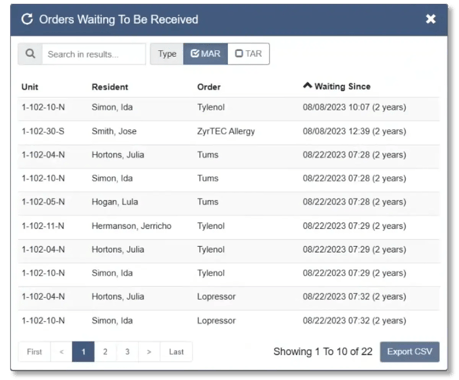
Eldermark eMAR, connected medication workflow view
Ties medication administration to the broader clinical record including the medication reconciliation process when residents transition in or out
Creates a more centralized picture of each resident
Reduces duplicate entry across care and pharmacy workflows
Connects documentation to billing so the care being delivered reaches an invoice
Gives clinical leaders a complete picture, not a series of disconnected data points

That is the difference between a system that documents med pass and a system that helps the building run better.

Implementation

What implementation should look like

Communities hesitate not because they think paper is better, but because they have been burned before. They worry the transition will be chaotic, staff will resist it, and the building will carry the implementation burden without enough support. That concern is legitimate.

A good eMAR implementation should feel structured, role-specific, and operationally grounded, not like the community is being asked to become its own software onboarding team.

1. Moving from paper MAR

Your team should understand what is changing, what data is being moved, when the workflow changes become live, and what the process looks like on the floor. Transparency at each stage reduces resistance and sets expectations clearly before day one.

2. Training by role

Clinical leaders, nurses, med techs, and administrators do not all need the same training. The right training reflects the actual day-to-day reality of each user, not a single generic walkthrough that works for no one specifically.

3. Go-live support

Questions will come up during the first days and weeks. The issue is not whether support is needed, it is whether the vendor is prepared to provide it quickly enough that staff stay confident and the workflow keeps moving.

4. Adoption in the first 30 days

The first month is where habits are formed. That period should reinforce the workflow, answer staff questions quickly, and catch issues before people start inventing workarounds that undercut the whole point of going digital.
FAQ

Frequently asked questions about Maryland's documentation update

Maryland's COMAR 10.07.14 does not name eMAR software by name. What it requires is medication administration documentation that is complete, time-stamped, attributable to the staff member who administered the medication, and retrievable on demand. That standard is difficult to meet consistently with paper MAR, which is why most Maryland operators are moving to eMAR to satisfy it.

The revised COMAR 10.07.14 regulations were effective November 1, 2025, with a six-month grace period. OHCQ began issuing citations rather than compliance checklists starting May 1, 2026.

OHCQ can issue deficiencies during surveys that become part of your facility's compliance record. Depending on severity and pattern, citations can escalate to corrective action plans or affect your licensure standing. The most straightforward way to reduce that risk is to have documentation that is clean, complete, and easy to produce when a surveyor asks.

Yes. Eldermark eMAR creates a complete, time-stamped, staff-attributed record of every medication administered. That documentation is retrievable on demand, which is exactly what OHCQ surveyors are looking for when they review medication records under Maryland's updated COMAR 10.07.14 standards.

Implementation timelines vary based on your community's size and current setup. We walk through that in the demo, including what data migration looks like, how training is structured by role, and what go-live support covers. Book a 30-minute demo to get a realistic picture for your specific situation.

Maryland Assisted Living Operators

Built for assisted living communities that need more than a digital replacement for paper.

Eldermark's eMAR is designed to help communities simplify medication administration, strengthen clinical documentation, and give clinical leadership the visibility they need to stay ahead of problems, not just respond to them.

Because medication administration in assisted living does not operate in isolation, Eldermark's eMAR connects to the broader resident record, giving clinical teams a more complete and accurate picture of care across the building.

For clinical leaders, that means a system that helps guide the work at the point of care, reduces the documentation burden on frontline staff, and creates a documentation trail that holds up when a Maryland surveyor asks for it.

See Eldermark eMAR in action.