Enterprise Intelligence Series
Senior Living Portfolio Management Starts with Operational Intelligence
As REITs expand SHOP exposure and consolidate fragmented senior housing portfolios, margin performance is no longer a function of occupancy — it's a function of operating discipline. This executive brief explains how institutional investors build the infrastructure for durable NOI.
90% Private-pay occupancy — near record highs
~20% Of U.S. senior housing units are REIT-owned
80+ Fastest-growing age cohort driving demand
The Institutional Challenge
Occupancy is no longer enough.
Margin must be engineered.
Senior living has entered its institutional era. Record occupancy levels, construction at its lowest point since 2012, and accelerating 80+ demographic expansion have made the investment thesis clear. Capital has followed.
But capital alone does not create margin.
As REITs increasingly operate under SHOP (Senior Housing Operating Portfolio) structures rather than traditional triple-net leases, operating performance is directly tied to capital returns. Margin compression impacts investors. Labor inefficiency erodes NOI. Revenue capture failures reduce portfolio performance.
The question is no longer "How full are we?" The questions are:
Why analytics rollouts fail before they start?
Is labor deployed proportionally to acuity demand?
Is care intensity aligned to the billing structure?
Is NOI resilient under cost pressure?
Get the framework for answering these questions at the portfolio level.
What's Inside
Written for Institutional Capital and the Operators They Back
This is not a feature sheet. It is a strategic framework for REITs and senior living management companies navigating consolidation, SHOP structures, and margin accountability in 2026 and beyond.
The SHOP Structure Shift
Under SHOP, REITs participate directly in operating income. Margin compression and labor inefficiency translate directly into reduced capital returns. Operating infrastructure has become capital infrastructure.
→You'll understand what this shift means for underwriting — and how to protect returns.
The Portfolio Normalization Problem
Consolidated portfolios inherit inconsistent assessment methodologies, variable service plan design, and non-uniform revenue mapping. Without normalization, analytics produce distortion — not clarity.
→ElderSmarts
closes the gap.
Margin Intelligence in Practice
True margin intelligence unifies acuity, service intensity, labor allocation, revenue capture, and cost structure — revealing what occupancy numbers never surface. Explored through a two-community case analysis.
→You'll have a framework for evaluating whether your portfolio has the data it needs.
Pre- and Post-Acquisition Intelligence
Model profitability before acquisition by revealing capture gaps and acuity distribution. Normalize operations quickly after — reducing the reporting lag that follows consolidation and compresses early-period returns.
→You'll know what questions to ask before the next acquisition closes.
Margin Intelligence in Practice
What Integration Reveals That Fragmentation Hides
Consider two communities of similar size — both appearing operationally stable at the surface level. Integrated analytics reveals meaningful differences in acuity, service delivery, and implied cost structure that occupancy numbers alone will never surface. This is the foundation of senior living software that thinks at the portfolio level.
| Community A | Community B | |
|---|---|---|
| Assessment Score | Lower avg. acuity score | Higher avg. acuity score |
| Service Minutes | Fewer service minutes per resident | More service minutes per resident |
| Service Intensity | Lower care complexity profile | Higher care complexity profile |
| Labor Burden (Cost of Care) | Lower implied cost of care | Higher implied cost of care |
Without integrated analytics, these dynamics remain invisible.
See the full two-community case analysis in the executive brief.
Savvy REITs are rewarding operators who demonstrate sustainable margin discipline — not merely filled units.
Who This Brief Is For
Three Audiences. One Framework.
Whether you own the assets, operate them, or protect their financial performance, this framework was built for you.

Managing SHOP exposure, underwriting decisions, and portfolio NOI. This brief provides the operational intelligence framework to evaluate whether acquired assets can deliver margin durability—not just occupancy.
Responsible for margin performance across multiple communities. This brief maps the operating standards, data infrastructure, and analytics capabilities that institutional investors increasingly require.
Revenue leakage is invisible in fragmented portfolios. This brief shows the direct relationship between front-end operational discipline and accurate, defensible NOI — and why service revenue integrity starts before billing.
Frequently Asked Questions
Common Questions About Senior Living Portfolio Management
SHOP stands for Senior Housing Operating Portfolio — a structure where the REIT participates directly in operating income rather than collecting a fixed triple-net lease payment. Under SHOP, margin compression and labor inefficiency translate directly into reduced capital returns. This makes operational discipline and structured performance data essential to portfolio management, not optional.
NOI in senior living is driven by the intersection of service revenue capture, acuity-aligned billing, labor cost discipline, and occupancy stability. Portfolios that rely on census alone miss margin leakage from under-billed services and misaligned care models. Accurate NOI evaluation requires community-level analytics that connect clinical documentation to financial outcomes.
Consolidation introduces inconsistent assessment methodologies, variable service plan design, fragmented billing structures, and non-standardized documentation across communities. Without operational normalization, these gaps prevent accurate acuity comparisons, true cost-of-care benchmarking, and reliable cross-portfolio reporting — meaning margin intelligence remains estimated rather than measured.
Senior living portfolio analytics integrates clinical data (acuity, service intensity, care documentation) with financial data (billing, revenue per care point, labor cost) to produce metrics institutional investors can act on — including risk-adjusted NOI forecasting, service margin transparency by community, and staffing demand alignment to acuity levels.
Before acquisition, operational intelligence enables profitability modeling by revealing service revenue capture gaps, acuity distribution, and labor cost exposure. Post-acquisition, it accelerates normalization by standardizing assessment frameworks and billing structures across communities — reducing the reporting lag that typically follows consolidation.
About This Series
Enterprise Intelligence Series
The Enterprise Intelligence Series from Eldermark examines the operational, clinical, and financial infrastructure required for senior living software performance at scale. Each installment is written for executives and ownership groups who make platform and strategy decisions.
Executive Brief No. 1
Why Senior Living Analytics and AI Start with Operations, Not the Dashboard
Executive Brief No. 2 — Current Page
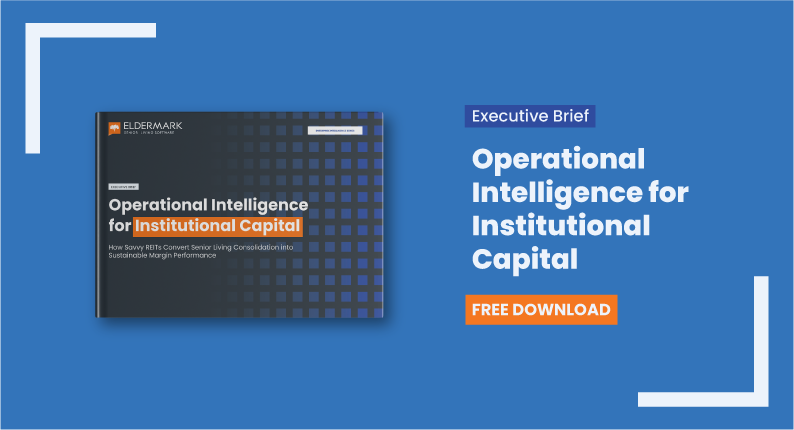
Operational Intelligence for Institutional Capital — How Savvy REITs Convert Senior Living Consolidation into Sustainable Margin Performance