For decades, risk management in senior living has been fundamentally reactive. A resident falls. An incident occurs. A hospitalization happens. The organization investigates what went wrong and determines how to prevent it from happening again. As a former operator for decades, I cannot count how many times this process was repeated, mostly within the forum of the safety committee or the quarterly quality assurance meeting. This cycle of event, response, and documentation has shaped the industry's approach to safety. But the environment has changed.
Residents are more complex. Care teams are stretched thinner. Clinical patterns are harder to detect. And the cost of reactive care, human, operational, and regulatory, has never been higher. The good news is that new approaches to risk management are available, thanks to technology.
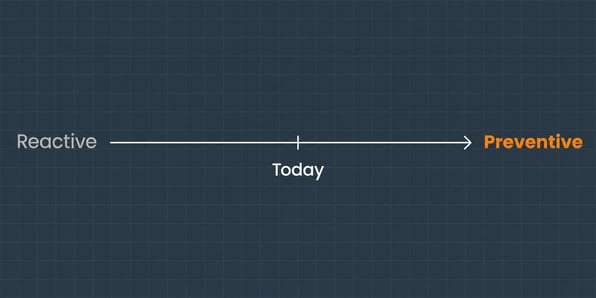
Emerging technologies are creating a new opportunity: identifying risks before adverse events occur. Predictive analytics and artificial intelligence are enabling providers to shift from reaction to prevention. Not by replacing caregivers, but by giving them better information earlier. This is the future of risk management. And Eldermark is the platform bringing that future into daily practice.
The Challenge with Traditional Risk Management
Traditional risk management
A look into the rear‑view mirror. What has already happened.
Predictive analytics
Patterns across data that reveal who is most at risk tomorrow.
Most risk‑management programs rely on historical information: incident reports, assessments, observations, and clinical records. These sources provide valuable insight into what has already happened, but they rarely reveal which resident is most likely to experience an adverse event tomorrow, next week, or next month.
The limitation is not the data. It is the lack of connection between data points. Predictive analytics changes that. By analyzing patterns across large volumes of resident information, predictive models can identify risk indicators that would otherwise go unnoticed, especially in environments where clinical expertise is unevenly distributed across shifts.
Eldermark's predictive intelligence is built precisely for this purpose: to surface risk trajectories early enough for teams to intervene meaningfully.
Fall Prevention Is a Natural Starting Point
Falls remain one of the most significant clinical, operational, and financial challenges in senior living. The causes are rarely simple. Risk factors include:
Chronic disease progression
Because these factors interact in complex ways, identifying elevated risk using traditional methods alone is difficult.
Eldermark's predictive fall‑risk model analyzes patterns across assessments, service delivery, clinical observations, and historical data to identify residents trending toward elevated risk, often before the risk is visible to staff. This is not about predicting the future with certainty. It is about recognizing patterns early enough to act.
Prediction Is Only Valuable If It Leads to Action
Artificial intelligence is not a replacement for caregivers. It is a tool that helps caregivers focus their attention more effectively. The true value of predictive analytics emerges only when insights are integrated into broader care‑management processes. This is where Eldermark's architecture stands apart.
When Eldermark identifies elevated risk, the system does not simply display a score. It connects prediction to action through:
Intervention mapping
Care‑planning automation
Workflow routing
Real‑time dashboards
Monitoring loops
Prediction becomes a trigger for operational change, guiding the clinician to answer important questions, like:
What interventions should be implemented?
How should the care plan adjust?
Which services need modification?
What should caregivers watch for?
When should the nurse be notified?
Prediction without intervention is information. Prediction with intervention is prevention. Eldermark is designed for the latter.
The Human Side of AI
Discussions about artificial intelligence often focus on algorithms and models. But the more important conversation is about people.
Caregivers are managing increasingly complex resident populations while navigating staffing shortages, turnover, and operational pressure. They are asked to make judgment calls in real time, often without the clinical training or credentials that those decisions require. Predictive tools do not replace their judgment. They support it. They help caregivers:
Identify emerging concerns
Reduce preventable events
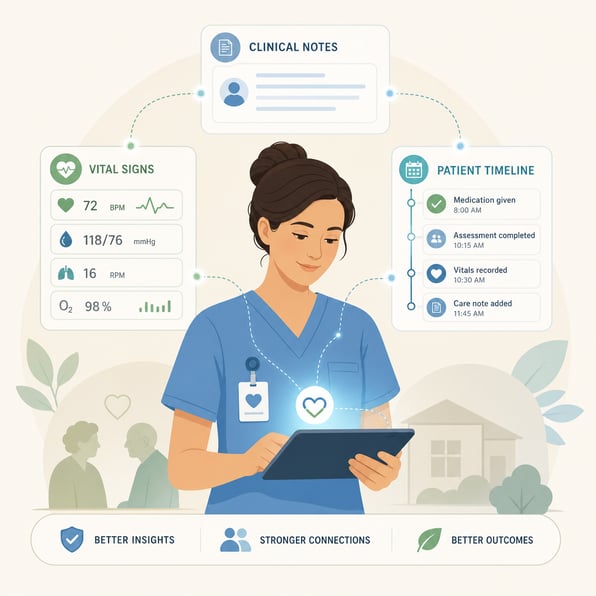
Eldermark's predictive intelligence is built to augment human decision‑making, not override it. It brings clinical insight to the point of care, especially in the moments when the nurse is not in the room.
Building the Future of Preventive Care
The future of senior living will be defined by organizations that combine:
Structured assessments + Evidence‑based interventions + Predictive analytics + Continuous monitoring + Workflow intelligence
Together, these capabilities create a care‑management ecosystem that identifies concerns sooner, responds more effectively, and reduces preventable adverse events.
Eldermark is the platform that brings these components together, not as isolated features, but as a unified care‑management system designed for the realities of today's senior living environment.
The opportunity is not simply to manage incidents more efficiently. The opportunity is to prevent more incidents from occurring in the first place.
As artificial intelligence continues to mature, its greatest contribution to senior living may not be automation. It may be the ability to help caregivers deliver safer, more proactive, more personalized care. Because in senior living, prevention will always be more valuable than reaction. And Eldermark is the system built to make prevention possible.

.png?width=596&name=Blog%20Part2%20Images-selection%20(3).png)