Free Checklist

The Ultimate Month-End Close Checklist for Assisted Living and Senior Living Communities

An eight-step, repeatable month-end close process to catch billing mistakes before statements go out.

Month-end close is where billing mistakes surface, if you catch them at all. This checklist walks through the close in order, from confirming services to closing the period, so nothing slips through on its way to a resident's statement.

Get the Printable PDF
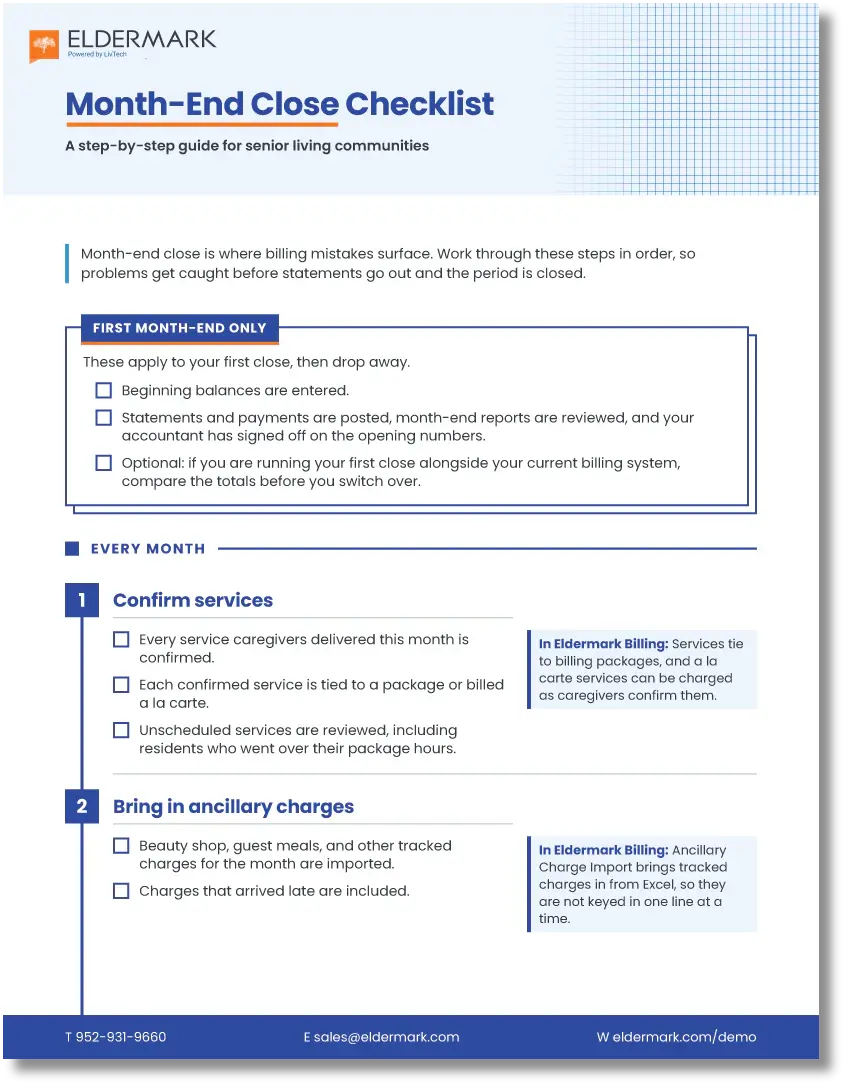
Month-End Close Checklist, printable PDF, page 1

What is month-end close?

Month-end close is the process of confirming every charge, posting every payment, and validating every report before you lock an accounting period. Once it's closed, that period is final. Anything missed has to be corrected in the next one.

Built for operators doing this themselves

Most small operators run month-end close without a dedicated billing team, an accountant on staff, or a second set of eyes. That makes a repeatable process the only real safeguard. Work through these steps in order, every month, and problems get caught before they reach a resident's statement instead of after.

In the printable version

The printable version adds a note under each step below showing exactly how that step works inside Eldermark Billing, so you can see where a manual process breaks down and where it doesn't have to.

The Checklist

First Month-End Only

These apply to your first close, then drop away.

Beginning balances are entered.
Statements and payments are posted, month-end reports are reviewed, and your accountant has signed off on the opening numbers.
Optional: if you're running your first close alongside your current billing system, compare the totals before you switch over.

Every Month

1

Confirm services

Every service caregivers delivered this month is confirmed.
Each confirmed service is tied to a package or billed a la carte.
Unscheduled services are reviewed, including residents who went over their package hours.
2

Bring in ancillary charges

Beauty shop, guest meals, and other tracked charges for the month are imported.
Charges that arrived late are included.
3

Review charges and adjustments

Billing setup is current: rates, fees, GL accounts (if you use them), and care level mapping.
Every new admission has a unit, a payor, and a monthly charge.
Recurring charges and fees are correct for each resident.
Care level changes since last month are reflected, and the evaluations behind them are finalized.
Care types are verified for each resident.
Prorated adjustments for move-ins, move-outs, and leaves of absence are reviewed.
Payors are correct, including couples and others who share a payor.
Credits and scheduled rate adjustments are applied as intended.
4

Create and review statements

Each statement shows the right previous balance, payments, and charges.
Move-in and move-out statements are created for anyone who moved during the month.
Couples and other residents who share a payor are on one combined statement. Insurance and Medicaid payors are the exception: each resident gets a separate statement.
5

Post payments

Payments received are recorded and applied to the right charges.
Credits are applied so balances and aging are accurate.
6

Run and review month-end reports

Run your Census report, Accounts Receivable Aging report, Rent Roll report, Revenue Roll report, Transaction report, and general ledger reports.
Compare totals to last month and look into large differences.
Resolve anything unexpected before moving on.
7

Hand off to your accountant

Share the reports with your accountant for review.
Export general ledger data if you keep your books in separate financial software.
8

Close the period

Every step above is complete.
Close the accounting period. It's a hard close: once closed it can't be reopened, and later adjustments post to the next period.

See How This Looks Inside Eldermark Billing

The printable checklist template includes a note under each step above showing how it works when billing software does the heavy lifting, from automatic prorated adjustments to statements that already know which residents share a payor.