It is easy to discuss clinical data quality in the abstract. Terms like "data integrity" and "documentation consistency" make sense in a presentation. They are harder to hold onto when you are sitting in a staff meeting trying to explain why your organization is not ready for AI yet.
A concrete example helps. The following scenario illustrates what is at stake when clinical information does not flow the way it should.
A Real-World Scenario
Case Scenario
A resident who was normally social and independent began skipping meals, refusing activities, and needing more assistance getting to the bathroom. The dining team noted she had not come to dinner two nights in a row. The activity team recorded that she declined two programs. A caregiver noted increased assistance with toileting.
Each observation was documented. But each was captured in a different place, by a different team member, with no single person seeing the full picture. No alert was triggered. No pattern was flagged.
Several days later, the resident appeared confused and was sent to the hospital. The diagnosis: a urinary tract infection and dehydration.
An AI tool might have recognized the combination of reduced intake, social withdrawal, and increased care needs as a potential change in condition. But it could only have helped if those observations were consistently documented, connected to the same resident record, and routed to someone responsible for reviewing and acting on the alert. The data existed. The infrastructure to connect it did not.
What This Scenario Illustrates
Three things stand out from this example:
1
Clinical signals are often distributed across teams. Dining, activities, and caregiving staff each observed something meaningful. None of them had reason to escalate alone. The pattern only becomes visible when those observations are connected.
2
"Documented" is not the same as "connected." Each team member did their job. The gap was not effort or attention. It was a system that was not designed to join those observations into a single view.
3
AI can only surface what the workflow is designed to capture. Alerts and pattern recognition depend entirely on the quality and completeness of what flows into the system in the first place.
Worth noting: AI cannot identify a change that the workflow has never been designed to capture. If the system only records that a task was completed, it may show full compliance while missing the more important clinical story entirely.
The Right Infrastructure Changes the Outcome
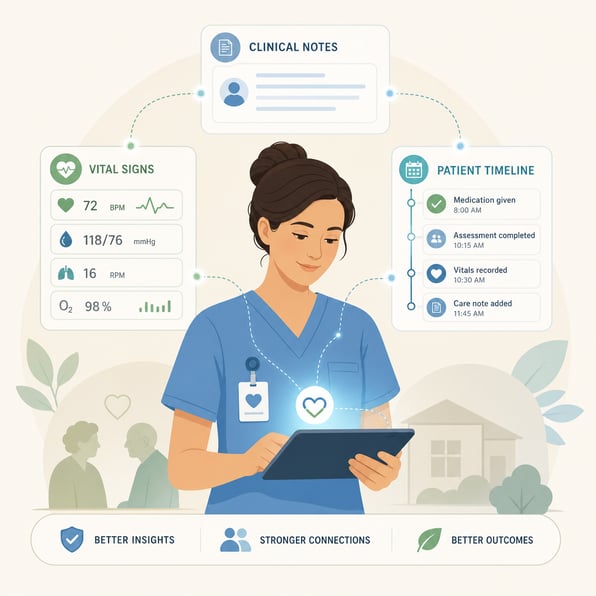
When clinical information is captured consistently, documented in the right place, and visible to the right people at the right time, the picture looks different. Staff can see patterns earlier. Supervisors can act before a situation escalates. And AI tools, when they come into the picture, have something meaningful to work with.
This Is What AI Readiness Actually Looks Like
AI readiness is not a technology question. It is a clinical information question. The organizations that will get the most value from AI are the ones that have already done the harder work of building a reliable clinical data foundation.
Part 4 of this series provides a structured framework your team can use to evaluate where you stand across four key dimensions of clinical data readiness.
"The difference between a good outcome and a difficult one often comes down to whether the right information was in the right place at the right time."
This scenario is not unique. Variations of it play out in senior living communities every day.
Ready to See Eldermark in Action?
Schedule a personalized demo and see how Eldermark works in practice, for your community, your team, your residents. Or start with the guide on getting your clinical data AI-ready.

.png?width=596&name=Blog%20Part2%20Images-selection%20(3).png)